Attached Home Roof Replacement in Elizabeth from $9,500. A shared wall changes the permit, the sequence and who has to agree to it. Free inspection and a written quote.
Across the city this is the lane most often misunderstood. The ordinary-maintenance exemption in N.J.A.C. 5:23-2.7 reaches DETACHED one- and two-family dwellings only, so a row house, a twin or a townhouse needs a construction permit for work that would need none next door. Nobody volunteers that, and it is the first thing we establish.
The ordinary-maintenance exemption in N.J.A.C. 5:23-2.7 applies to DETACHED one- and two-family dwellings. A row house, a twin or a townhouse is attached, so the exemption does not reach it and a construction permit is required even for a like-for-like covering replacement. Nobody volunteers this, and it is the single most common misunderstanding in this city.


The roofing costs what roofing costs -- the same New Jersey range. What changes on an attached house is that the ordinary-maintenance exemption does not reach it, so a construction permit is required for work that would need none on the detached house across the street. Budget the time, not just the fee. Two things move an Elizabeth quote before the roof does. Whether the building is detached, attached or three-plus units, which decides whether you are waiting on a permit. And access, because a frontage that has to carry material up and waste down is labor that a suburban quote does not contain.
The fee is modest. The filing and the inspection are what put days into the job, and a contractor who tells you an attached row house needs no permit is either mistaken or hoping.
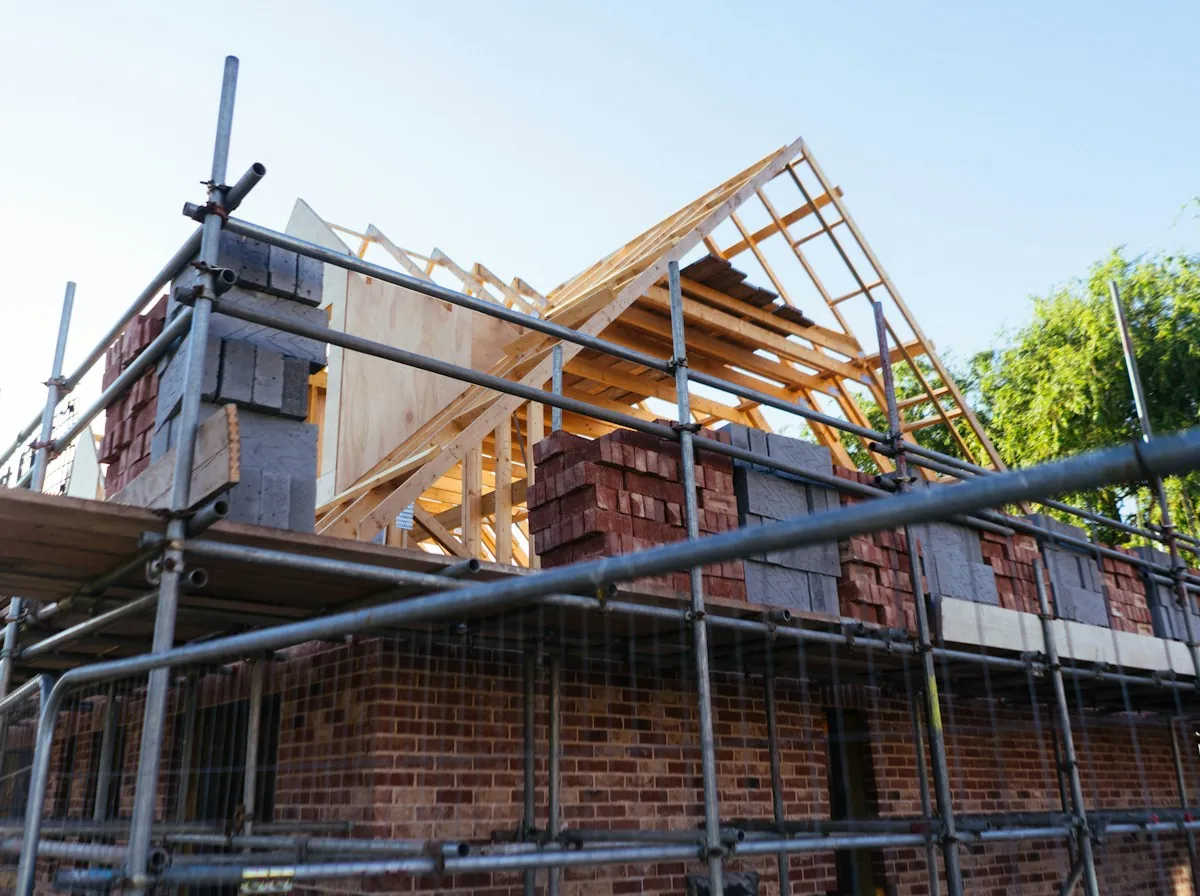
The party-wall or parapet junction, which is hand-worked and is the detail that decides whether the roof holds. And access: no side yard means material up the front and waste down the front.
Doing a run of attached properties together, if neighbors are willing. One mobilization across three roofs is markedly cheaper than three, and the shared junctions get done properly in one go rather than twice from one side.
The first question on any Elizabeth roof is whether the building is detached, attached or has three or more units, because that decides whether the job is permitted work at all. The answer changes street by street here, which is why it gets established on the survey rather than assumed from the ZIP code.
Elizabeth's housing spans more building eras and more dwelling types than anywhere else in Union County, which is exactly why one answer about permits does not cover the city.
The work itself changes as well. Where a roof runs into a neighbor's at a party wall, the detail at that junction is the part that leaks, and it cannot be done properly from one side alone in every case. Flashing into a shared parapet, stepping over a height difference, terminating a membrane at a boundary -- these are the details that decide whether the job holds.
It comes up twice in what people search for here, and it is Florida's. What actually decides this in New Jersey is simpler.
Look away from the leak. If the covering across the rest of the slope still lies flat, still holds its granules and is not brittle, the roof has life in it and the repair is the right job. A failed flashing, a split upstand or a lifted course is hundreds of dollars, and each is routinely produced as proof the whole roof is finished.
Two coverings is the practical ceiling. A roof already at two is a tear-off whatever anybody quotes. It takes two minutes to check at the rake edge and it is the fastest way to tell whether the quotes in front of you are describing the same job.
On an attached house a repair can be ordinary maintenance while the replacement is permitted work -- so the smaller job is also the faster one. That is worth knowing on a marginal roof. It should not decide a clear one.
The first question on an Elizabeth roof is not the covering, it is the building.
Architectural shingle installs at $5.50 to $8.00 per square foot in New Jersey against $4.50 to $6.50 for three-tab, and on an Elizabeth roof that spread is the difference between two quotes that look otherwise identical.
Low slope is everywhere in this city -- rear extensions, porch roofs, whole roofs on older attached stock.
Standing seam runs $10 to $19 per square foot in New Jersey, roughly double architectural shingle.
A building with three or more dwelling units is outside ordinary maintenance whatever its roof needs, so across Elizabeth a multi-family roof is permitted work from the start.
The most detached part of the city. Often no permit.
Two-family houses, sitting exactly on the line.
Close-set stock, and the rear extension question.
Two- to four-family. Assume a permit and be right.
Waterfront wind. It finds the edge detail first.
Detached township, and a different construction office.
Wide plots, so the city's access costs disappear.
The questions that decide this job, answered up front.
Yes. The ordinary-maintenance exemption in N.J.A.C. 5:23-2.7 applies to DETACHED one- and two-family dwellings, so a row house, a twin or a townhouse needs a construction permit even for like-for-like covering replacement. A contractor who tells you otherwise is either mistaken or hoping nobody checks.
Not for work on your own roof, but you may need their access, and asking early is much easier than asking on the day. Where a covering terminates into a shared parapet or steps over a height difference, doing it properly sometimes means reaching over the boundary -- and that is a conversation, not a problem.
An architectural asphalt roof in New Jersey runs $9,500 to $26,000, and on a typical 2,000 square foot house most people pay $12,000 to $18,000 installed. Per square foot that is $5.50 to $8.00 for architectural shingle and $4.50 to $6.50 for three-tab. National calculators read low here because northern-climate detailing is not optional.
It is Florida Building Code, Existing Building, section 706.1.1: not more than 25 per cent of a roof area may be repaired, replaced or recovered in any twelve-month period unless the whole system is brought up to current code. It is quoted all over the country because it sounds universal. It is not New Jersey law, and in New Jersey the question that decides your job is whether your dwelling is detached.
Not automatically. Age tells you to look, not what to do. A twenty-year-old architectural roof that still lies flat, still holds its granules and has sound flashings can have years left; a twenty-year-old three-tab on a shaded northern slope may be finished. What settles it is the condition of the field away from any failure, and the number of layers already up there.
Free inspection, and the permit question answered before any price. New Jersey figures, not a national calculator.