Flat Roof Replacement in Elizabeth from $5. EPDM, TPO or modified bitumen, priced per square foot, and the drainage looked at first. Free inspection and a written quote.
Low slope is everywhere in this city -- rear extensions, porch roofs, whole roofs on older attached stock. New Jersey pricing runs $5 to $14 per square foot by system, and what fails is almost never the middle of the membrane. It is the outlet, the parapet and the upstand at a wall.
Flat roofing in New Jersey installs at $5 to $14 per square foot depending on the system: EPDM $5 to $9, TPO $6 to $12. On a 1,500 square foot section that is $7,500 to $13,500 in EPDM against $9,000 to $18,000 in TPO, tear-off and insulation included.


New Jersey flat roofing installs at $5 to $14 per square foot depending on the system -- EPDM $5 to $9, TPO $6 to $12, tear-off and insulation included. On a 1,500 square foot section that is $7,500 to $13,500 in EPDM against $9,000 to $18,000 in TPO. Two things move an Elizabeth quote before the roof does. Whether the building is detached, attached or three-plus units, which decides whether you are waiting on a permit. And access, because a frontage that has to carry material up and waste down is labor that a suburban quote does not contain.
Water still standing 48 hours after rain means the fall is wrong or the outlet is not working. In a freezing climate that is worse than it sounds: water that freezes in a lap lifts it mechanically. Re-covering over it buys a couple of winters.
Parapets, copings and internal outlets, each of which is a detail to be formed and flashed. Insulation, which is a real part of the cost and should be stated. And occupied units underneath, which decide the sequence.
EPDM is the least expensive and on a small rear extension it is frequently the correct choice. TPO earns its premium on larger areas and where reflectivity matters. We will say which applies rather than defaulting to the pricier one.
The first question on any Elizabeth roof is whether the building is detached, attached or has three or more units, because that decides whether the job is permitted work at all. The answer changes street by street here, which is why it gets established on the survey rather than assumed from the ZIP code.
Elizabeth's housing spans more building eras and more dwelling types than anywhere else in Union County, which is exactly why one answer about permits does not cover the city.
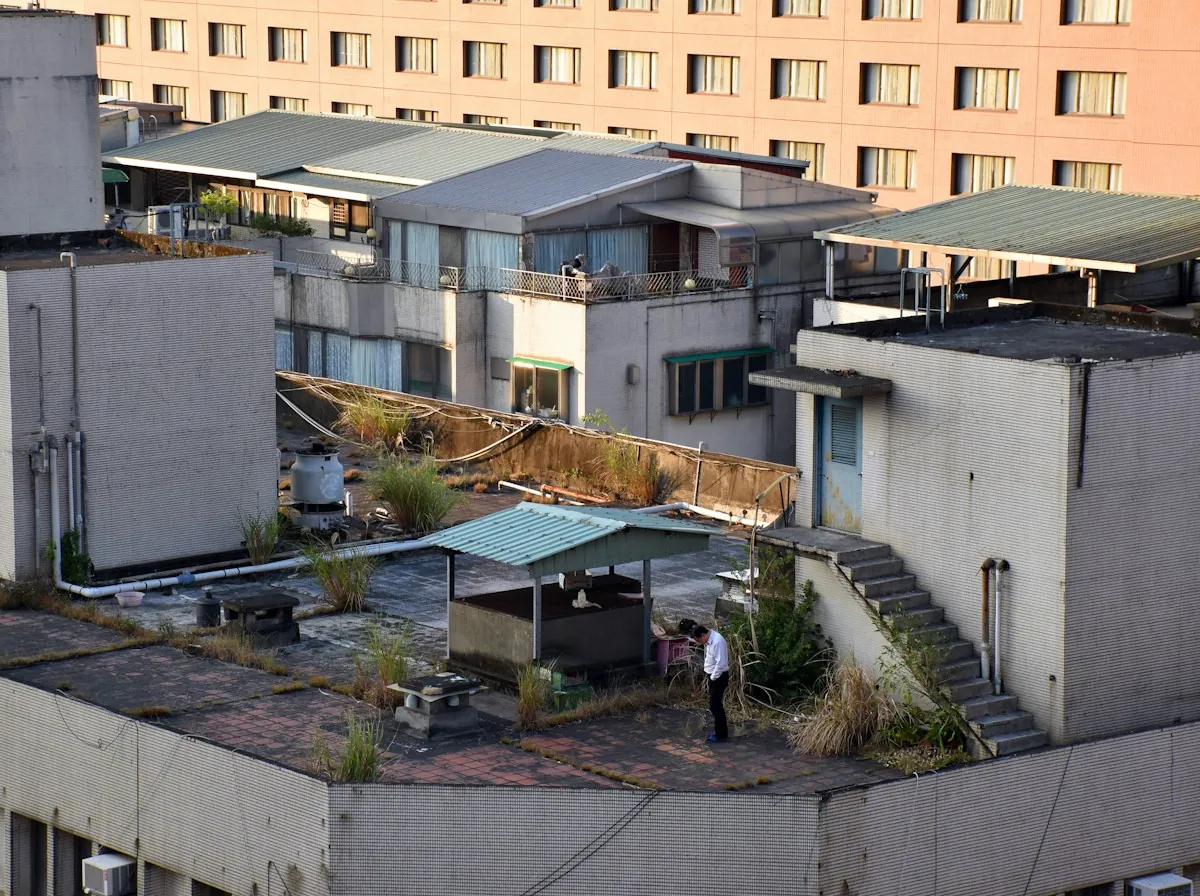
There is a great deal of low slope in this city -- rear extensions, porch roofs, whole roofs on older attached stock -- and what fails is rarely the membrane in the middle of the field. It is the outlet, the parapet, the coping and the upstand at a wall. Water that cannot leave finds the weakest one of those and stays until it does.
It comes up twice in what people search for here, and it is Florida's. What actually decides this in New Jersey is simpler.
Look away from the leak. If the covering across the rest of the slope still lies flat, still holds its granules and is not brittle, the roof has life in it and the repair is the right job. A failed flashing, a split upstand or a lifted course is hundreds of dollars, and each is routinely produced as proof the whole roof is finished.
Two coverings is the practical ceiling. A roof already at two is a tear-off whatever anybody quotes. It takes two minutes to check at the rake edge and it is the fastest way to tell whether the quotes in front of you are describing the same job.
On an attached house a repair can be ordinary maintenance while the replacement is permitted work -- so the smaller job is also the faster one. That is worth knowing on a marginal roof. It should not decide a clear one.
The first question on an Elizabeth roof is not the covering, it is the building.
Across the city this is the lane most often misunderstood.
Architectural shingle installs at $5.50 to $8.00 per square foot in New Jersey against $4.50 to $6.50 for three-tab, and on an Elizabeth roof that spread is the difference between two quotes that look otherwise identical.
Standing seam runs $10 to $19 per square foot in New Jersey, roughly double architectural shingle.
A building with three or more dwelling units is outside ordinary maintenance whatever its roof needs, so across Elizabeth a multi-family roof is permitted work from the start.
The most detached part of the city. Often no permit.
Two-family houses, sitting exactly on the line.
Close-set stock, and the rear extension question.
Two- to four-family. Assume a permit and be right.
Waterfront wind. It finds the edge detail first.
Detached township, and a different construction office.
Wide plots, so the city's access costs disappear.
The questions that decide this job, answered up front.
More urgent than in a warm climate. Water still sitting 48 hours after rain means the fall is wrong or the outlet is blocked, and in a freezing winter that water expands inside laps and under flashings and lifts them mechanically. It is what turns a membrane job into a deck replacement over a couple of winters.
EPDM at $5 to $9 per square foot is the cheaper system and on a small rear extension it is frequently the right one. TPO at $6 to $12 earns its premium on larger areas and where reflectivity matters. We will tell you which applies to your roof rather than defaulting to the pricier one.
An architectural asphalt roof in New Jersey runs $9,500 to $26,000, and on a typical 2,000 square foot house most people pay $12,000 to $18,000 installed. Per square foot that is $5.50 to $8.00 for architectural shingle and $4.50 to $6.50 for three-tab. National calculators read low here because northern-climate detailing is not optional.
It is Florida Building Code, Existing Building, section 706.1.1: not more than 25 per cent of a roof area may be repaired, replaced or recovered in any twelve-month period unless the whole system is brought up to current code. It is quoted all over the country because it sounds universal. It is not New Jersey law, and in New Jersey the question that decides your job is whether your dwelling is detached.
Not automatically. Age tells you to look, not what to do. A twenty-year-old architectural roof that still lies flat, still holds its granules and has sound flashings can have years left; a twenty-year-old three-tab on a shaded northern slope may be finished. What settles it is the condition of the field away from any failure, and the number of layers already up there.
Free inspection, and the permit question answered before any price. New Jersey figures, not a national calculator.